Key takeaways
- An AI factory's return depends on a few engineering answers. When they arrive late, they come back as change orders, schedule slips or stranded capacity, and all three come out of the return.
- Power is the asset. Firm megawatts by a date, backed by an interconnection agreement, are a different asset from a larger number that can be curtailed, and the design and revenue model must both say which one they assume.
- Rack density now spans more than a factor of four, from about 48 kW to 246 kW per rack across current and announced NVIDIA and AMD platforms.7,12 A building designed for today's rack can be obsolete when the next generation arrives.
- Cooling and water choices largely set operating cost and permitting risk for the life of the asset.
- Responsibility gaps between facility, IT and GPU-cloud operator are SLA risk. They should be written down before the money is committed, not after the first incident.
An AI factory is sold to investors as compute capacity: megawatts, GPUs, tokens. It is built as a set of engineering commitments, though: a utility connection, a power distribution system, a cooling plant, a building that can carry the racks. The gap between the two is where returns are lost. In Drybulb's experience, many of the most expensive changes on these projects come from answers that arrived late, not from bad engineering. The rack weight shows up after the slab is poured. The coolant temperature changes after the heat-rejection yard is laid out. The utility capacity turns out to be curtailable, not firm.
Drybulb starts every AI factory design and design-review engagement with a structured intake questionnaire. It goes to the owner's program lead, the compute lead, the design team and the site or colo operator. Any important question left unanswered goes into the proposal as a written assumption, so someone visibly owns that risk. The same questions belong in an investor's diligence. This article sets out the ones that matter most to capital, why they matter, and what a weak answer looks like.
Power is the asset
The power position is usually the binding constraint on an AI factory, and the first thing to test. A few questions do most of the work.
How many megawatts are firm, and by what date? The useful answer names the utility voltage, the firm capacity available on each date, and the status of the will-serve letter or interconnection agreement. "Capacity is available" without a document behind it is a hope, not an asset.
How much of it is firm and how much is curtailable? Interruptible or flexible-load capacity can be a sensible commercial trade. It also changes the design, because ride-through, load shedding and backup all have to be sized for the curtailment terms. Investors should know which kind of capacity the revenue model assumes.
How will the facility handle training-load swings? Large training jobs alternate between compute-heavy and communication-heavy phases, and the resulting power swings grow with job size.11 Swings like that can stress generators, UPS and upstream protection, and can breach ramp-rate or power-quality terms in the interconnection agreement. A credible project has a stated approach to this, whether that is power smoothing at the GPU, battery storage, or terms agreed with the utility. Drybulb's BESS testing note covers what qualifying that storage involves.
Density and obsolescence risk
The range of rack power has become so wide that no single "typical AI rack" exists. NVIDIA's DGX SuperPOD reference architecture places four DGX B300 systems in a conventional AC-powered EIA rack at about 56 kW.1 Vertiv's reference architecture for GB300 NVL72 supports up to 142 kW per rack, with air- and hybrid-cooled facility configurations.2 Schneider Electric's Vera Rubin NVL72 reference design runs at 188 kW per rack at Max-Q and 227 kW at Max-P.3 On the AMD side, Supermicro lists 48.47 kW rack power for its air-cooled MI350X rack (SRS-48UAC-MI350-8U4N: four 8U servers of eight GPUs each, 32 GPUs),12 and Gigabyte's liquid-cooled MI355X rack lists up to 120 kW for 64 GPUs.5 The Schneider Electric and AMD Helios reference design reaches 246 kW per rack.7
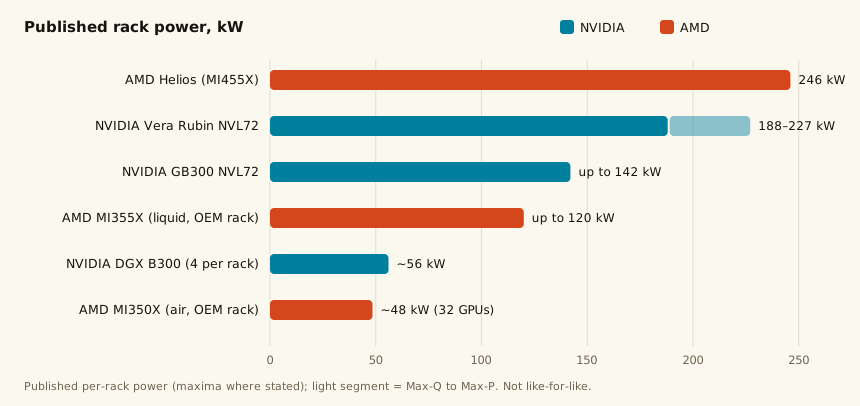
Fig. 1 — The spread a facility has to be designed for. Published per-rack power (maxima where stated) for current and announced NVIDIA and AMD platforms, from vendor and OEM sources.1,2,3,5,7,12 These are not like-for-like comparisons: GPU count, rack format and what each publisher counts all differ.
A hall designed for 56 kW AC-powered EIA racks1 and a hall designed for 246 kW liquid-cooled Open Rack Wide racks6,7 share almost nothing below the ceiling. That carries two risks.
Stranded or short capacity. Rack power is three numbers, not one: nameplate, the operating point (such as Max-Q or Max-P, or an OEM power cap), and the sustained average. Nameplate sets connected load. The operating point sets the load the plant must hold. The average sets energy cost. Design to nameplate and capacity that was paid for sits unused. Design to the average and the facility falls short the day a training job holds the cluster at full power. Electrical code continuous-load rules applied to rack kW are another common place where capacity gets stranded without anyone deciding to strand it.
Obsolescence. A building, its substation and its piping outlive several GPU generations. Ask which platform the facility is designed for, and which next platform it can accept without a rebuild: rack power, distribution voltage and cooling temperature. The power interface at the rack is moving. Options now range from 480 VAC distribution3 through in-rack DC power shelves to high-voltage DC, including the ±400 VDC sidecar in OCP's Mt Diablo specification, which is designed to scale IT racks "from 100 kilowatts up to 1 megawatt."8 Drybulb's 800VDC analysis covers that transition. A project that can't say how its next tenant's racks will be powered is designed for one generation, not for a long-lived asset.
Cooling, water and operating cost
Liquid-cooled rarely means all of the heat goes to liquid. Hybrid racks still reject part of their heat to air, and air-cooled racks reject all of it. The Register's coverage of AMD's MI350 launch noted that air-cooled MI350X configurations "will almost certainly require the use of rear-door heat exchangers."4 Supermicro's air-cooled MI350X rack puts four 8-GPU servers (32 GPUs) in one rack at about 48 kW, all of it leaving the servers as hot air.12 The split between liquid and air sets the size, and cost, of both cooling plants. It should come from the OEM's facility interface guide for the exact product, not from a press release.
Supply temperature sets the plant and the power bill. Schneider Electric's Vera Rubin reference design calls for a 45 °C supply on the rack-side cooling loop.3 The facility water feeding that loop has to be colder by the approach of the coolant distribution unit (for example, Gigabyte rates the in-rack unit on its MI355X rack at a 5 °C approach5). ASHRAE's fifth-edition thermal guidelines classify facility water from W17 to W45 and W+ by its upper supply temperature.9 Warmer water means more hours without chillers and pushes heat rejection toward dry coolers. That changes yard area, water use, noise and PUE together, and so changes operating cost for the life of the asset. Drybulb's PUE and Cost Model tools show how far that one choice moves annual energy for a given site.
Water can rule out a cooling concept. Water supply, discharge limits and any cap on annual water use can rule out evaporative cooling entirely. Zoning, entitlements and local ordinances on generation, battery storage or cooling towers belong in the same review. They are schedule and permitting risk, and are cheapest to find before closing.
Tenant flexibility: rack format and mixed fleets
Rack format has become a building question. AMD's Helios is built on the OCP Open Rack Wide specification, a double-wide rack carrying 72 MI455X GPUs, with liquid coolant delivered to the trays through quick disconnects.6 The DGX B300 reference uses conventional EIA racks.1 Row spacing, aisle width, door sizes and the delivery route from the loading dock all depend on the format.
For an investor, this is a question about who else the hall can serve. A facility designed to one envelope covering the supply temperatures, flows, connectors and power interfaces of more than one platform can be re-leased to a different tenant or the next generation. A facility designed tightly around one rack can't. Ask whether NVIDIA and AMD racks, or several generations of either, are expected to share halls, power systems or cooling loops, and how the design accommodates that.
Schedule risk
Long-lead equipment sets the schedule. Ask for procurement status and lead times on transformers, switchgear, generators, coolant distribution units, dry coolers and busway. Lead times fix the schedule, and the schedule fixes when the design has to freeze. Energization dates in a model that are earlier than the equipment can arrive are a red flag.
Testing at real load. Ask whether integrated systems testing will run at full design coolant flow and temperature, with liquid-cooled load banks. Air load banks do not test the liquid path, and testing under real liquid and electrical load is where design gaps surface. It is better to find them there than after paying tenants move in.
Operational risk: sequences and responsibilities
Some of the most important answers carry no number at all.
Shutdown logic must be designed, not assumed. Which fire-alarm and leak events shut down IT equipment, cooling units, pumps and batteries? What is the emergency power-off policy? For many operators, liquid in the white space is a new risk. The sequence of what closes, what trips and what keeps running should exist before commissioning.
Responsibilities must be written down. The facility operator, the IT owner and any GPU-cloud operator now share live data and control. Rack and cooling telemetry flows to the compute management stack, and workloads can be throttled on a facility event. A responsibility matrix across physical, environmental and IT layers is what turns an uptime SLA into something enforceable. Drybulb's telemetry article makes the case for treating that data layer as infrastructure.
An unanswered question doesn't go away. It comes back later as a change order.
A diligence short list
| Ask | A weak answer looks like | Possible exposure |
|---|---|---|
| Firm MW by date, with the interconnection document | "Capacity is available" with no signed agreement | Revenue start slips; curtailment not priced |
| Firm vs. curtailable split | Not distinguished | Ride-through and backup sized to the wrong terms; firm capacity overstated in the revenue model |
| How training-load swings are handled | Not addressed | Possible interconnection non-compliance, protection trips, retrofit storage |
| Rack kW: nameplate, operating point, average | One number | Stranded capacity, or a facility that runs short |
| Next platform accepted without rebuild | "Today's rack" only | Early obsolescence |
| Cooling supply temperature and water limits | Generic, or "TBD" with no date | Operating cost and permitting risk |
| Rack format and mixed-fleet plan | Single-tenant assumption | Re-leasing difficulty |
| Long-lead procurement status | Dates without purchase orders | Schedule-slip exposure |
| Shutdown sequences and responsibility matrix | "Operator will handle" | SLA disputes, outage exposure |
These are typical failure modes, not predictions for any given project.
Documents to ask for
A short paper trail lets these questions be checked rather than taken on trust. It includes the basis of design and owner's project requirements, the OEM facility interface guide for the exact product, the utility will-serve or interconnection documents, electrical one-line diagrams, mechanical flow diagrams with sequences of operation, the energy and water model, the commissioning plan, the responsibility matrix and the project schedule. Ask too which reference designs the owner has contractually adopted: NVIDIA's DGX SuperPOD or DSX blueprints, Schneider, Vertiv or Siemens reference designs, AMD Helios, OCP specifications, or ASHRAE and Uptime guidance. That decides what is a requirement and what is only guidance. For scale, NVIDIA's DSX blueprint models a reference campus on a 50-acre site.10
None of this replaces the design. It makes sure the investment rests on answers rather than assumptions, and that the assumptions which remain are written down, priced, and owned by someone.
References & fact-check
- NVIDIA, "NVIDIA SuperPOD with DGX B300 Systems, NVIDIA Quantum-X800 InfiniBand switching and AC Power Reference Architecture": four DGX B300 per rack; rack-level power "~56kW"; AC-powered EIA racks with traditional PDUs. docs.nvidia.com
- Vertiv, "Vertiv develops energy-efficient cooling and power reference architecture for the NVIDIA GB300 NVL72 platform," June 11, 2025: rack densities up to 142 kW; air- and hybrid-cooled configurations. vertiv.com
- Schneider Electric, "NVIDIA and Schneider Electric get in sync at NVIDIA GTC 2026 to deliver Vera Rubin AI Factories," May 8, 2026: Vera Rubin NVL72 at Max-Q 188 kW/rack and Max-P 227 kW/rack; TCS loop supply 45 °C; 480 VAC distribution. blog.se.com
- The Register, AMD Instinct MI350X / MI355X launch coverage, June 12, 2025: MI355X 1.4 kW liquid-cooled; MI350X 1 kW TDP; air-cooled configurations likely requiring rear-door heat exchangers. theregister.com
- Gigabyte, GIGAPOD AI DLC Rack for AMD Instinct MI355X: 64 GPUs in 8 × 4U liquid-cooled servers; up to 120 kW rack power; in-rack liquid-to-liquid CDU 100 kW at 5 °C approach. gigabyte.com
- AMD, "Helios" rack-scale platform: 72 Instinct MI455X GPUs per rack; built on OCP Open Rack Wide (double-wide); liquid coolant to trays via quick disconnects. amd.com
- Schneider Electric and AMD, "Schneider Electric and AMD release first Helios platform reference design to accelerate AI Factory deployment," July 23, 2026 (via Taiwan News): up to 246 kW per rack; clusters up to 10.4 MW IT. taiwannews.com.tw
- Open Compute Project, "Major Contributions Advance OCP Open Systems for AI at APAC Summit," August 5, 2025: Mt Diablo ±400 VDC disaggregated power (sidecar) rack, designed to scale IT racks from 100 kW up to 1 MW. opencompute.org
- Upsite Technologies, "Major Changes to ASHRAE's Fifth Edition of Thermal Guidelines, Part 3: Liquid Cooling Chapter Updates," July 31, 2024: facility water classes W17, W27, W32, W40, W45, W+. upsite.com
- NVIDIA, "Overview — Omniverse DSX Blueprint": digital twin of the DSX reference design for a 50-acre site; gigawatt-scale AI data centers. docs.omniverse.nvidia.com
- E. Choukse et al. (Microsoft, OpenAI, NVIDIA), "Power Stabilization for AI Training Datacenters," arXiv:2508.14318, August 2025: training iterations alternate compute-heavy and communication-heavy phases, producing power swings that grow with job size; mitigations span GPU power floors, workload injection and energy storage. arxiv.org
- Supermicro, "AMD Instinct rack-scale solutions" (L11 rack table): SRS-48UAC-MI350-8U4N-R0, air-cooled, AS-8126GS-TNMR servers with 8× MI350X; rack power 48.47 kW (for the medium cluster size). The same table lists the liquid-cooled 8-server MI355X rack at 120.36 kW. supermicro.com
Methodology & caveats: The questions in this article are drawn from Drybulb's AI factory design intake. Platform figures are vendor- and OEM-published as of October 2026. They are directional, not like-for-like (GPU count, rack format and what each publisher counts all differ), and should be confirmed against the OEM facility interface guide for the exact product. This article is independent technical commentary for planning purposes. It is not investment advice, and not a substitute for project-specific design by the Engineer of Record or for the codes and standards adopted on a given project.
Evaluating an AI factory investment and want an independent technical read? Get in touch.
Drybulb publishes deep technical writing on AI factory and data center engineering. Questions or topics you'd like to see covered? Get in touch.