Key takeaways
- The AI factory has made the battery an active power-system element — buffering hundreds-of-megawatt GPU ramps, riding through grid disturbances, and supporting demand response — not the UPS backup appliance it used to be.
- There are three layers of assurance — product certification, vendor self-qualification, and project-specific testing — and only the third validates this battery, on this interconnection, with this facility's load.
- NVIDIA's own guidelines concede the point: "passing qualification does not imply site-level stability," and the qualification boundary stops at the BESS AC terminals.
- The fire code now agrees. NFPA 855 (2026) makes the installation-specific Hazard Mitigation Analysis the default and requires large-scale fire testing proving a fire in one unit won't propagate to the next — claims only meaningful for the as-built layout.
- The capability to validate before energizing already exists. NREL's ARIES platform can impose real faults and weak-grid conditions on a physical BESS at up to 20 MW and 34.5 kV.
For two decades the battery in a data center had exactly one job: bridge the half-second between a utility sag and the diesel coming up to speed. It sat in the UPS, it was sized in minutes of runtime, and nobody asked it to be clever. The AI factory has ended that arrangement. The battery is now an active element of the power system — and the way the industry validates it has not caught up.
NVIDIA frames the shift plainly: power-dense training and inference workloads produce "rapid changes in power demand" that stress the interconnection, turning the battery's job into "a control, quality, and interconnection problem"2 rather than merely a capacity one. A modern battery energy storage system (BESS) is now asked to smooth hundreds-of-megawatt GPU ramps, ride through grid disturbances while compute keeps running, support demand-response commitments, and — increasingly — help turn constrained interconnection timelines into a solvable engineering problem. It is, in NVIDIA's words, an "integrated part of the AI factory power stack," not a backup appliance.
That is not a niche idea anymore. In June 2026 Siemens and Fluence completed a battery framework built to NVIDIA's specification11 for AI data centers, with LG Energy Solution and others aligning their grid-storage products to the same guidelines. When a battery is buffering the GPU's load swings and holding the bus through a fault, its dynamic behavior has become production-critical infrastructure. So how do we actually know it works?
The assurance stack: three layers, and the gap in each
Ask whether a BESS is "qualified" and you will get three very different answers, because there are three distinct layers of assurance — each necessary, none sufficient on its own.
Layer one is product certification. UL 9540 and UL 9540A3, NFPA 8554, IEEE 1547 and IEEE 2800 establish that a representative configuration of the product behaves acceptably. These are the table stakes — and they are tested on a typical case, not your case.
Layer two is vendor self-qualification. This is genuinely new, and NVIDIA's BESS Self-Qualification Guidelines1 are the most rigorous example yet: twelve tests spanning telemetry accuracy, grid-adaptive voltage and frequency regulation, current-limit characterization, AI-ramp buffering, low- and high-voltage ride-through against the IEEE 2800 baseline, seamless grid/island transition, black start, and a 24-hour state-of-charge-drift test — each demanded with hardware evidence and a validated electromagnetic-transient (EMT) model. The governing principle is exactly right: if a capability is claimed, it must be demonstrated with data and/or validated models. It is a real step up from a certificate.
Layer three is the one nobody can outsource: project-specific testing. It is the only layer that validates this battery, on this interconnection, with this facility's load. And here is the uncomfortable part — the people who wrote the most demanding self-qualification in the industry will tell you, in writing, that layers one and two do not get you there.
Passing qualification does not imply site-level stability.
— NVIDIA, BESS Self-Qualification Guidelines1
NVIDIA draws the boundary of its own qualification at the BESS AC terminals, and is explicit about what falls outside it: "site transformers, line reactors, switchgear, relays, generators, and campus control systems are not qualified here."1 In other words, the certification and the self-qualification both stop precisely where your project begins.
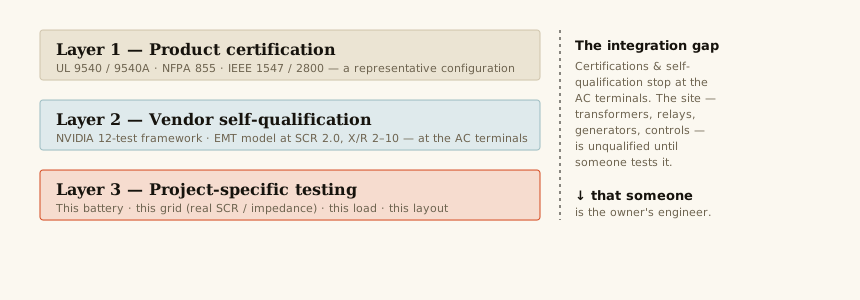
Fig. 1 — The integration gap. Each assurance layer is necessary and none is sufficient. The vendor's qualification boundary sits at the BESS AC terminals; everything downstream — the actual interconnection and balance of plant — is validated only by project-specific work. Refs 1–4.
The electrical case: why "typical" fails on a real grid
The reason site-level behavior cannot be inferred from a bench test is physics, not paperwork. A grid-forming power-conversion system is a closed-loop controller interacting with the impedance of the network it is bolted to. Its stability depends on the short-circuit ratio (a measure of grid strength), the X/R ratio, and the specific disturbance and ramp profiles it sees. NVIDIA's framework demands EMT validation at a short-circuit ratio of 2.0 across X/R ratios from 2 to 10 precisely because a weak interconnection can provoke oscillation, limit-cycle hunting, or control-mode instability that a stiff lab grid will never reveal — and a failure there is automatic non-qualification.1
But the short-circuit ratio at your substation, the X/R of your service, the reclose logic of your protection, the droop settings of your on-site generators, and the millisecond shape of your particular GPU cluster's ramp are yours — they are not in any vendor's test plan. NVIDIA says as much: reliable site assessment requires modeling "ramp rates, expected minimum and maximum demand, power factor, UPS operating modes, protection settings, reconnect logic, onsite generation behavior, and BESS controls"2 — without which planners cannot reliably assess whether the site will support or stress the grid during normal operation, disturbances, or recovery.
Nor can you fall back on precedent. NVIDIA notes that interconnection standards "don't yet cover behaviors AI factories need" — load smoothing, transition-adaptive operation, coordinated response with on-site generation — and that "few deployments have run long enough to establish performance benchmarks for these duties."2 When the standards and the field history are both thin, the only honest evidence is a study of your own system.
The fire code agrees: NFPA 855 (2026) now mandates installation-specific analysis
If the electrical argument feels like a vendor's caution, the safety argument is now codified. The 2026 edition of NFPA 855 moved decisively toward installation-specific evaluation. The headline change: a Hazard Mitigation Analysis (HMA) is now the default requirement for virtually all energy-storage installations5, with the old Chapter 9 maximum-stored-energy table — and its capacity-based exemptions — removed6.
An HMA is, by definition, project-specific work. It must address thermal-runaway initiation and propagation for the specific technology and configuration, gas generation and deflagration hazards (invoking NFPA 68 and NFPA 69), containment and separation strategy, and the application of UL 9540A data at the system and facility level. The 2026 edition also makes large-scale fire testing explicit alongside UL 9540A and requires it to demonstrate that a fire involving one ESS unit will not propagate to an adjacent unit6 — a claim that is only meaningful for the as-installed arrangement, not a catalogue cut sheet. It adds thermal-runaway-propagation-prevention provisions (§9.7.6.6), broader detection options per NFPA 72 (§14.3.2.1.2), a standing emergency-response-plan requirement (§4.3.3), and Annex G guidance that a registered fire-protection engineer experienced in ESS risk assessment should direct the analysis.
This matters even for the certificate you already hold: UL 9540A characterizes a representative configuration, and the authority having jurisdiction needs a report matching the actual installation scenario, as fire engineers like Jensen Hughes7 have stressed in the wake of the large-scale-fire-test changes. One caution: adoption is local — many jurisdictions still enforce earlier editions, so the governing edition must be confirmed with your AHJ.
So the two disciplines that most rarely agree — power-systems engineering and fire protection — have arrived at the same conclusion from opposite directions. Generic listings are necessary and insufficient; you owe a site-specific demonstration.
How — and where — you actually test it
Project-specific testing is not a vague aspiration to "do more." It is a concrete set of deliverables: a site-specific EMT and stability study run at your real short-circuit ratio and impedance, with your actual AI-ramp profiles and on-site generation in the loop; integrated commissioning that exercises the BESS together with the protection scheme, UPS operating modes, reclose logic, and generators rather than in isolation; an AI-duty-cycle and state-of-charge validation across the simultaneous missions the battery will actually serve; an installation-specific HMA and large-scale-fire-test basis for the AHJ; and a commitment to keep those models validated as the facility evolves.
And the capability to do this before energizing already exists. The U.S. Department of Energy's National Renewable Energy Laboratory operates the ARIES platform at its Flatirons Campus8 — a multi-megawatt grid-integration test bed positioned as a launch pad for industry partners to evaluate how large-scale energy systems interact with the grid. It supports hardware and simulation up to roughly 20 MW and 34.5 kV. Its Controllable Grid Interface can impose programmable faults, voltage sags and swells, frequency excursions, and weak-grid conditions on a real device — exactly the SCR and ride-through envelopes that matter. Its power-hardware-in-the-loop capability9 couples a physical BESS to a real-time-simulated model of your interconnection, which is precisely the "hardware evidence plus validated EMT model" pairing NVIDIA asks for — at field scale. ARIES has even carried NREL's own campus through a real outage10 in islanded operation, the same grid-master, black-start, and seamless-transition duties an AI-factory BESS must perform.
The convergence
Electrical — "Passing qualification does not imply site-level stability." The qualification stops at the AC terminals.
Fire & safety — NFPA 855 (2026) makes the installation-specific Hazard Mitigation Analysis the default and requires testing that one unit's fire won't spread to the next, for the as-built layout.
Both point to the same place — a generic, certified product is the beginning of the validation, not the end of it.
The owner's position: where the risk actually lives
For an owner, a developer, or a lender, the practical lesson is about where to look for risk. A binder full of certifications and a vendor's self-qualification report are the price of admission — they are not proof that the system fits the site. The gap between a qualified product and a qualified installation is exactly where schedule risk (an AHJ that rejects a mismatched fire-test report), capital risk (a battery that oscillates on a weak interconnection and de-rates the plant), and safety risk (a propagation path that only exists in the as-built arrangement) accumulate.
That gap is closed by independent, project-specific validation — performed by an engineer who answers to the owner rather than to the equipment vendor, who reads the EMT study and the HMA with the same skepticism, and who has no incentive other than getting the engineering right. The most rigorous self-qualification framework in the industry has already conceded the point in writing. The certificate proves the product can work somewhere. Only the project proves it works here.
References & fact-check
- NVIDIA, "BESS Self-Qualification Guidelines" (NVIDIA DSX documentation) — partner-run qualification framework, 12 tests, EMT validation at SCR 2.0 / X/R 2–10, "passing qualification does not imply site-level stability," AC-terminal qualification boundary. docs.nvidia.com
- NVIDIA Technical Blog, "Designing Production-Ready Battery Energy Storage Systems for AI Factories" — "control, quality, and interconnection problem," BESS as integrated power-stack element, required site-level modeling, gaps in interconnection standards. developer.nvidia.com
- UL Solutions, "UL 9540A Test Method for Battery Energy Storage Systems" — thermal-runaway fire-propagation test method, representative configuration. ul.com
- UL Solutions, "Understanding UL 9540A, NFPA 855 and Large-Scale Fire Testing for BESS" — relationship of UL 9540A to NFPA 855 and the fire code. ul.com
- Energy-Storage.News, "NFPA 855: 2026 edition updates and what they mean for energy storage projects" — HMA now default, large-scale fire testing, TRPP, detection/suppression, emergency response. energy-storage.news
- Engineering Fire Protection, "NFPA 855 (2026 Edition) — What's New for Battery Energy Storage Systems" — removal of Chapter 9 max-stored-energy exemption table, HMA contents, large-scale fire test "won't propagate to an adjacent unit," §9.7.6.6 / §14.3.2.1.2 / §4.3.3 / Annex G. engineeringfireprotection.com
- Jensen Hughes, "How LSFT is Reshaping BESS Design + Compliance" — large-scale fire testing and the need for installation-specific reports for the AHJ. jensenhughes.com
- NREL, "Grid Integration Facilities at the Flatirons Campus" (ARIES) — multi-megawatt grid-integration test bed, up to 20 MW / 34.5 kV, Controllable Grid Interface. nrel.gov
- NREL, "ARIES: Capabilities" — power-hardware-in-the-loop, real-time simulation, controllable grid interface. nrel.gov
- NREL, "An Unexpected Debut: ARIES Microgrid Infrastructure Powers NREL Campus Through Outage" (2020) — islanded operation through a real outage. nrel.gov
- pv magazine USA, "Siemens and Fluence complete NVIDIA battery framework for AI data centers," June 2026 — industry adoption of NVIDIA's BESS framework. pv-magazine-usa.com
Methodology & caveats — This note synthesizes NVIDIA's published BESS Self-Qualification Guidelines and AI-factory engineering blog, UL Solutions and fire-engineering commentary on UL 9540A, reputable reporting on the NFPA 855 2026 edition, and NREL's public descriptions of the ARIES / Flatirons test platform, through June 2026. Specific NFPA 855 section numbers reflect secondary summaries; confirm against the adopted edition of the standard and your authority having jurisdiction. This is independent commentary for planning purposes — not a substitute for a project-specific engineering study, nor for the governing edition of any code or standard as adopted locally.
Drybulb publishes deep technical writing on AI factory and data center engineering. Questions or topics you'd like to see covered? Get in touch.