Key takeaways
- Data center load lost on faults is growing. Fault-induced transfers to backup power in Northern Virginia grew from about 1,500 MW (July 2024) to about 3,800–3,900 MW (July 2026). Each began with a normally cleared fault; the sites' own UPS and transfer logic removed the load.1,2,3
- A GPU campus is not a legacy IT load. Synchronous training swings tens of megawatts at 0.2–3 Hz, overlapping grid electromechanical modes, and dip-counting transfer logic plus constant-power rectifiers turn routine reclosing into a common-mode loss.4,5
- Binding rules now exist in ERCOT, Dominion, AEP, SPP, Finland and Ireland. With the leading proposals, they converge on riding through six sags in 90 s, no dip counting, 90% power back in 0.5–3 s, a 150% current cap and ramps of roughly 10–30 MW/min.6,7,8,9,10,34
- Curtailment arrives through the connection gate (Ireland, Alberta, Texas, SPP). FERC rejected PJM's curtail-first service on October 9, 2026.11,12,13
- UPS firmware, transfer settings, rectifier current limits, power-factor control and BESS sizing are now grid-compliance items, not internal reliability choices.
At about 7:00 p.m. on July 10, 2024, a lightning arrestor failed on a 230 kV line in Dominion Energy's Northern Virginia zone. Auto-reclosing at both ends produced "6 successive system faults in an 82-second period," each lasting 42–66 ms, with load-area voltage sagging to 0.25–0.40 pu.1 No utility breaker disconnected a customer. Yet about 1,500 MW of "exclusively data center-type load" left the system, removed by the customers' own protection and controls.1 NERC traced it to transfer logic: "The typical number of voltage disturbances that trigger this scheme is three, and a typical time is one minute." About 1,260 MW dropped on the third dip "and did not return for hours."1 The data centers protected their IT load exactly as designed, and in doing so created a gigawatt-scale disturbance.
Two years of load-loss events
The pattern repeated. A February 17, 2025 single-line-to-ground 230 kV fault, cleared in about 5.9 cycles, produced four voltage depressions and about 1,800 MW of customer-initiated load reduction (CILR) according to NERC and PJM; PJM-side press reporting gave about 1,500 MW.3,14,15 Faults on May 3 and June 19, 2025 removed about 540 and 1,300 MW.14 Then settings changes showed what is possible: on April 18, 2026, a similar fault in the same area caused "only 500 MW of sustained data center load loss," after operators "lengthened the time duration required for measuring voltage dips to be 'counted.'"16
Three months later came the largest event yet. On July 22, 2026, a 230 kV fault led to roughly 3,800 MW transferring to backup; reporting ACE reached +3,928 MW and frequency 60.092 Hz, with "no relay misoperations or stuck breakers."2 PJM's later deck revises the total to about 3,900 MW: about 2,900 MW in a first wave, then "roughly ~1,000 MW of CILR a minute later" as voltage peaked near 1.138 pu.3 NERC called it a "nearly 4 GW customer-initiated load reduction… demonstrating that the risk is increasing, not abating."16
Texas and Ireland have their own records. ERCOT counted 26 trip events since 2023 (as of December 2025);17 NERC's draft cites 32 events of 100 MW or more through April 2026, mostly crypto mining, and notes ERCOT "has not observed any VRT events at a traditional data center."14 Ireland has had five faults since 2022 with data center demand drops of 74 to 480 MW (16–52% of data center demand).18
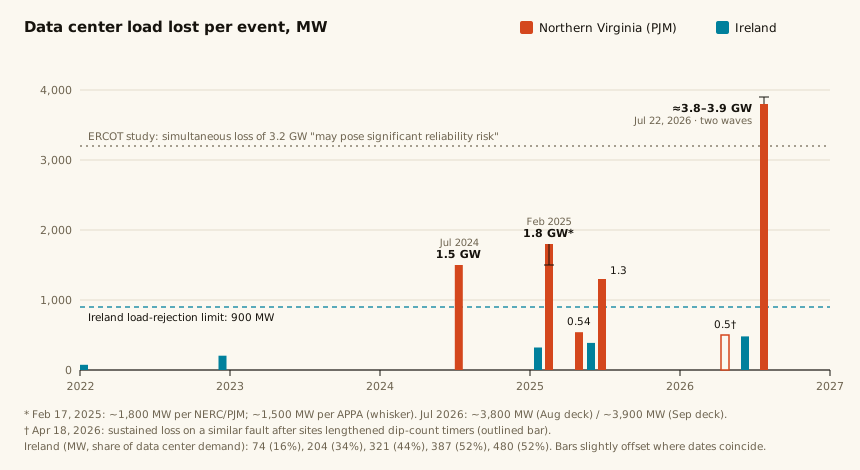
Fig. 1 — The trend regulators are reacting to. Customer-initiated reductions of data center load after normally cleared transmission faults, by date. The Irish bars look small, but Ireland's data center demand is about 26% of all-island minimum demand, so a 480 MW drop is a system-level event against a 900 MW load-rejection limit. Refs 1, 2, 3, 9, 14, 15, 16, 18.
Ireland shows what this does to a small system. The TSOs treat 900 MW as the largest manageable load rejection and assume 90% of data center demand can drop on a credible fault. In late June 2026 data center demand neared 1,000 MW, the limit "was reached," and interconnector exports were cut.18 EirGrid also paused raising its non-synchronous penetration limit from 75% to 80% because of the ride-through issue.9 Data center behavior now caps renewable operation. No comparable event has been documented in Asia-Pacific, Latin America or the Middle East; regulators there cite Virginia and Ireland as precedent.19
The physics: why a GPU campus is not a legacy IT load
To the grid, a traditional data center is a large, flat load that occasionally disappears onto its generators. An AI training campus differs in four ways, and each rule below targets one of them.
The load is synchronized. Training alternates compute and communication phases across thousands of GPUs at once. Microsoft, OpenAI and NVIDIA researchers report swings of "tens of megawatts" in one data center and "tens or hundreds of megawatts" at scale, with spectral energy at 0.2–3 Hz, overlapping inter-area and plant modes and approaching turbine torsional modes from about 7 Hz.4 NERC warns that cycling in the "0.1–2 Hz" electromechanical range can cause "widespread forced oscillations," and that oscillations have already occurred at a crypto facility in ERCOT and a data center in Dominion.5
The protection logic is common-mode. Dip counting protects servers from a sick utility. But multi-shot reclosing on a permanent fault is the grid working as designed, and when every site on a network applies the same three-dips rule, they all leave together. NERC: "all computational loads on a circuit could see the same disturbance and take the same action."16 Some fleets compound it: for DRUPS, retransfer to the grid "must be done manually."1
The front end holds power constant. Double-conversion UPS units hold power constant through a dip, which can deepen it, and unstandardized reconnection risks "flapping."20 At constant power, current scales as 1/V, so full power at 0.67 pu means 150% current; ERCOT observed 150–200% in real events.21
Shedding load pushes voltage and frequency up. In July 2024 voltage rose to 1.07 pu and operators removed capacitor banks;1 in July 2026 the overvoltage from the first wave tripped the second.3 One ERCOT voltage event "became a frequency control event" at 60.235 Hz for over 10 minutes.22 High-voltage ride-through is now a design case.
The grid did not fail. Sites tripped on normally cleared faults that reclosing practice creates on purpose.
— The common thread of every documented event
Ride-through and post-fault recovery: the envelope is converging
North America
NERC moved from study to near-mandate in about 20 months. Its May 4, 2026 Level 3 alert is not a standard, but reporting was mandatory. It asks for PERC1-class models with "UPS settings and configurations" and "expected maximum ramp rate (MW/min) up and down," a ±10% voltage step test at commissioning, dynamic fault recorders, and compliance with operator instructions.23 On July 16, 2026 FERC ordered NERC to file computational-load standards and registry criteria by December 31, 2026, with penalties of up to $1,584,648 per violation per day once registered.24 Phase 1 "will not address the minimum voltage or frequency ride-through"; that is expected in a 2027 standard.2 The registration threshold is unsettled: 20 MW at 60 kV in NERC's April proposal, 50 MW at 100 kV in a later draft known only from a PJM slide.2,25 NERC's draft ride-through white paper recommends ERCOT's curve as a national floor, extended to full reclosing sequences and cooling load, with 1 s recovery "achievable and appropriate" in strong systems and up to 10 s in weak ones.14
ERCOT's NOGRR 282 is the most complete adopted load ride-through rule anywhere. Approved by the PUCT on July 9, 2026 and effective August 1, 2026, it covers sites of 75 MW or more that are at least half power-electronic computational load (scope per the companion NPRR 1308), with sites energized or contracted by November 14, 2025 exempt.6,21,26 Beyond the envelope in Fig. 2 and Table 1, it lets sites trip for overvoltage above 1.08 pu lasting 5 s only until January 1, 2028, requires continued consumption at 0.5–0.8 pu after that date (proportional reduction allowed) or a compliant transfer scheme, lets cooling trip only below 0.35 pu, and sets a 90/90/180-day root-cause and correction cycle with disconnection possible under imminent risk.6 Jurisdictional challenges were left unaddressed.27
PJM has no binding RTO-wide load requirement yet. Its September 15, 2026 proposal, Manual 14B Attachment D-2, largely transplants ERCOT for loads of 50 MW or more at 60 kV and above, starting with projects entering study on January 16, 2027.28 Dominion's Attachment 8 already binds: data centers above 50 MW "must demonstrate the capability to ride through at least six automatic reclosing attempts that last 50–70 milliseconds each."7 AEP's Rev 7 requires only "two consecutive voltage excursions" outside 0.92–1.05 pu.29 Southern Company has published no load ride-through or ramp requirements that this research could find; its practice is known only through CAISO's survey.10 CAISO's June 15, 2026 straw proposal is the most demanding US draft on sag duration (6 s below 0.9 pu) but the slowest on recovery (3 s), with a FERC filing targeted for November 16, 2026.10,30 SPP's HILL rules, effective January 15, 2026, add telemetry, remote disconnect, a customer-funded PMU and ride-through guidelines for loads of 50 MW or more above 69 kV.31,32
Europe and Australia: faster clocks
Ireland's MPID345 requires demand to stay connected through faults and return to "at least 90% of its prefault Active Power Demand within 500 ms," with ±1 Hz/s RoCoF withstand. Sites may ride on backup during the dip provided grid draw returns in time.9 Industry argued no "off the shelf" solution exists; the CRU's adviser found "no feasible, practical, or deliverable technical alternative."9,33 The CRU approved it on September 22, 2026, with the Grid Code deemed amended five weeks later (October 27, 2026). It endorsed EirGrid's derogation framework with amendments: data centres face a Demand Utilisation Threshold on demand that is not ride-through capable, compliance plans are due within six months, and the proposed portfolio approach was rejected.34 The proposed 24-month derogation caps non-compliant demand in MVA, a direct commercial lever on existing sites.18
Fingrid's requirements (June 12, 2026; new demand of 30 MW or more) demand survival of eight 100 ms three-phase faults in 90 s and 90% recovery within 1 s, using storage or resistors if needed.8 (NERC's draft lists Fingrid at 0.5 s;14 Fingrid's text says 1 s.) The EU Demand Connection Code has no load ride-through clause and its revision is stalled, so ENTSO-E's non-binding December 2025 template asks TSOs to set recovery of 80–100% within 0.5–5 s and RoCoF withstand up to ±4 Hz/s over 0.25 s.35,36 Belgium has consulted on rules above 75 MW; Great Britain has none adopted.37,38
Australia's ERC0394 draft (final due October 29, 2026) would require 500 ms recovery under the automatic standard, cap consumption at 110% during undervoltage, extend overvoltage ride-through to 130% and bar trips "based solely on the number of faults." The AEMC concedes "some UPS models… cannot withstand 130% overvoltages" but argues recovery can usually be fixed "through control system changes rather than hardware changes," a claim Irish industry disputes.19,39
Elsewhere, obligations are soft. Saudi Arabia asks loads to mitigate "transient voltage dips" qualitatively;40 Mexico requires load centers to ride ±10% voltage for 20 minutes, per a vendor summary;41 Chile instead requires a large client to study the grid impact of its own sudden trip and add redundancy if needed;42 India has no load ride-through code;43 and Singapore puts dip mitigation on the customer.44
Table 1 — Ride-through and recovery: where the rules converge
| Instrument | Status | Sag envelope | Repeated faults / counters | Recovery to 90% | Current / power cap | Frequency / RoCoF |
|---|---|---|---|---|---|---|
| ERCOT NOGRR 282 | Adopted eff. Aug 1, 2026 | 0.8–0.9: 2 s · 0.5–0.8: 0.5 s · 0.35–0.5: 0.25 s · <0.35: 0.15 s · 1.1–1.2: 1 s6 | Counters banned; ≥6 sags/swells in 90 s | 2 s; transfer schemes 0.5 s | ≤150% for ≤0.5 s | 58.8–61.2 Hz continuous; 299 s to 57.5/63.0 Hz |
| PJM M14B Att. D-2 | Proposed Sep 15, 2026 | As ERCOT to 0.5 pu; <0.5: 0.25 s28 | Count-only schemes barred; 6 in 90 s | 2 s | ≤150% for ≤0.5 s | 299 s to 57.0/61.8 Hz |
| Dominion FIR Att. 8 | Adopted Rev 2.0, Apr 1, 2026 | — | Six reclosing attempts of 50–70 ms; 80–120 ms timer recommended7 | Not specified | — | UFLS participation required |
| AEP Rev 7 | Adopted Dec 31, 2025 | ITIC/CBEMA minimum29 | Two excursions outside 0.92–1.05 pu | — | — | — |
| CAISO straw | Proposed Jun 15, 2026 | <0.9: 6 s · <0.7: 3 s · <0.5: 1.2 s · <0.25: 0.15 s · 1.1–1.2: 2 s10 | Cumulative over 10 s windows | 3 s | — | 299 s to 57.0/61.8 Hz; RoCoF under evaluation |
| NERC LLWG white paper | Draft Jul 30, 2026 | ERCOT curve as national floor14 | Full multi-shot reclosing | 1 s strong to 10 s weak systems | — | IEEE 2800 / PRC-029; ≥±2 Hz/s |
| Ireland MPID345 | Approved Sep 22, 2026 | Grid Code V–t profile (breakpoints not extracted)9 | — | 0.5 s | — | ±1 Hz/s |
| Fingrid | Adopted Jun 12, 2026 | No disconnection at 0.5–0.9 pu8 | Eight 100 ms faults in 90 s | 1 s | — | 2.0 Hz/s over 1 s; RoCoF relays banned |
| Australia ERC0394 | Draft final due Oct 29, 2026 | Deep sag 240 ms (auto) / 140 ms (min); OV to 130%19 | Count-only trips barred; vector shift ≥20° | 0.5 s (auto) / 1 s (min), to 90–110% | ≤110% of pre-fault power in undervoltage | Trip only if >4 Hz/s for 0.25 s or >3 Hz/s for 1 s |
| ENTSO-E Annex A | Non-binding Dec 11, 2025 | UV and OV profiles (figures)36 | — | 0.5–5 s, to 80–100% | — | ±4.0 Hz/s over 0.25 s … ±1.25 Hz/s over 2 s |
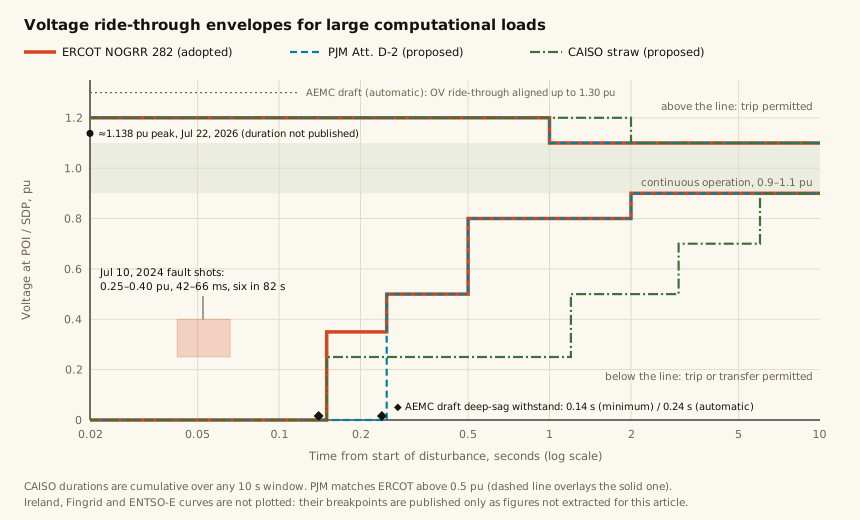
Fig. 2 — Three North American envelopes, one shape. The line is the lowest (or highest) voltage the load must ride through for the time shown; below the undervoltage line, trip or transfer is permitted. Only envelopes with numeric breakpoints in the source documents are drawn. Note how far the July 2024 reclosing shots sit inside every envelope: each shot was ride-through territory; the count of shots was the problem. Refs 1, 3, 6, 10, 19, 28.
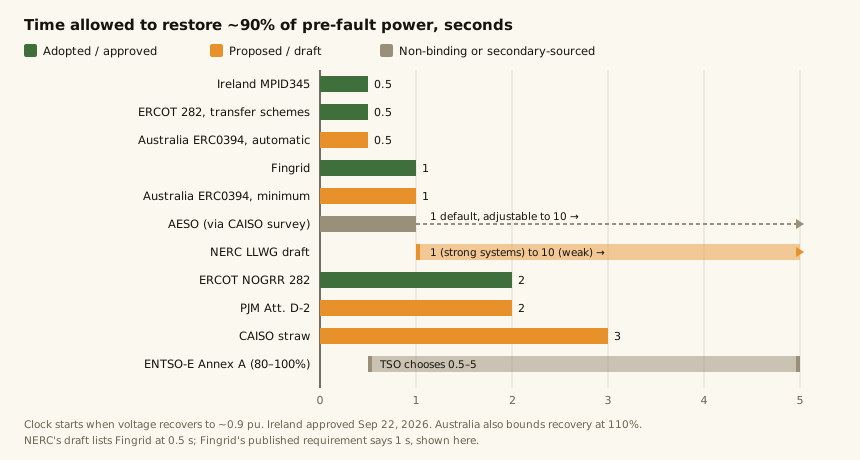
Fig. 3 — The recovery clock. Europe and Australia allow a quarter to a half of ERCOT's two seconds. A site that transfers to generators and returns to the grid only after a minutes-long stable-utility timer cannot meet any of these. Refs 6, 8, 9, 10, 14, 19, 28, 34, 36.
Ramp rates and oscillation limits
Ride-through rules govern what a site does when the grid misbehaves. Ramp and oscillation rules govern what the site does to the grid, and here the record is thinner and often second-hand.
Where ramp limits exist they cluster at 10–30 MW/min (Table 2). SPP's adopted cap is 20 MW/min;32 CAISO proposes 20 MW/min over a rolling 10 minutes;10 Fingrid requires a selectable 5–50 MW/min limiter and a 50 MW step cap.8 Dominion's often-quoted ~10 MW/min is a classification trigger for "non-conforming" load, not a cap.45 ERCOT has no adopted MW/min limit that this research found, despite a 20 MW/min entry in CAISO's survey; it manages swings through Regulation, which large-load swings exceeded in 255 five-minute intervals in the year to February 2024.10,22
Numeric oscillation limits are rarer. Dominion requires minimal injection in four bands from 0.01 to 55 Hz;7 Fingrid sets per-band limits from 0.01 to 45 Hz, under which a 300 MW site may cause at most 12 MW peak oscillation at 1 Hz.8 NERC has published no number.5 An academic review reports a 23 Hz, 50 MW peak-to-peak oscillation at an ERCOT large load in October 2024, unconfirmed by any primary source.46 IEEE P4200, authorized June 4, 2026, will cover "oscillation and ramp rate management, power quality" for data centers, but is years from publication.47
Table 2 — Ramp, step and oscillation limits on large loads
| Instrument | Status | Ramp limit | Step / short-window variation | Oscillation / spectral limit |
|---|---|---|---|---|
| SPP HILL | Adopted Jan 15, 2026 | ≤20 MW/min up and down32 | <25 MW over 5 s (via CAISO)10 | — |
| CAISO straw | Proposed Jun 15, 2026 | 20 MW/min average, rolling 10 min10 | — | Under evaluation (SSR/SSTI/SSCI) |
| Southern Co. (via CAISO) | Utility practice | 20 MW/min; P75 1-min ramp ≤20 MW/min10 | <10 MW over 4–6 s | — |
| ATC (via CAISO) | Utility practice | Changes >50 MW at <0.5 MW/s (30 MW/min)10 | <25 MW over 5 s | — |
| AESO (via CAISO) | Utility practice | 10 MW/min10 | — | — |
| LIPA (via CAISO) | Utility practice | — | — | <10 MW at 0.1–5 Hz; <3.5 MW at 5–55 Hz10 |
| Dominion FIR | Adopted | ~10 MW/min with ~50 MW swings triggers "non-conforming" status (not a cap)45 | — | Minimize 0.01–0.5, 0.5–0.8, 0.8–2, 5–55 Hz7 |
| Fingrid | Adopted Jun 12, 2026 | Selectable 5–50 MW/min8 | ≤50 MW single step | Per band 0.01–45 Hz; 300 MW site ≤12 MW at 1 Hz |
| ENTSO-E Annex A | Non-binding | TSO-set, no number36 | — | TSO-set, 0.01–50 Hz |
| AEMO ERC0455 | Proposed Jul 21, 2026 | Short-timeframe limit, no number48 | — | — |
| ERCOT | None adopted | None found (CAISO survey lists 20 MW/min; unconfirmed) | — | — |
| Mexico Código de Red | Adopted (vendor summary) | — | Load switching may not shift frequency >±0.1 Hz41 | — |
| Saudi Grid Code | Adopted Issue 3, 2021 | Notify demand-control changes ≥5 MW/h40 | Repetitive voltage steps ≤1% of nominal | Flicker Pst 0.8 / Plt 0.6 |
"Via CAISO" means the figure appears only in CAISO's June 2026 survey of utility practice and is secondary.
Mitigation has a cost. The Microsoft/OpenAI/NVIDIA paper reports that GB200 power smoothing floors GPU power at up to 90% of TDP, that a 90% floor cost 10.5% extra energy in simulation, and that GPU smoothing alone cannot hold a 10 MW dynamic range on a 100 MW job; it recommends combining GPU smoothing, rack storage and site BESS.4 These single-paper, vendor-affiliated figures are directional.
Curtailment, demand response and flexible connection
Mandatory curtailment of data centers is real but narrow, and it is almost always a condition of connection rather than an operating rule.
- Ireland (adopted December 12, 2025): sites of 10 MVA or more must bring dispatchable generation or storage matching their import capacity and cannot "ramp up to its full MIC" until it is delivered. Compliant sites are exempt from Mandatory Demand Curtailment; others can be cut on 60 minutes' notice.11
- Alberta (in force June 9, 2026): bridged data centers "reduce demand before any other market participant."12
- Texas SB 6 (signed June 21, 2025): loads of 75 MW or more need curtailment equipment installed before interconnection, but ERCOT listed the protocol as "Not Started" in May 2026 and no interface specification exists.49
- SPP CHILLS (accepted June 5, 2026): curtailable transmission service "for up to seven years" (an earlier description said five).50,51
- Australia: South Australia can direct sites of 100 MW or more to vary load "by up to 100%"; NSW proposes 25% cuts for up to two hours for sites of 15 MW or more, and "diesel generators are not to be used for load flexibility."52
- Defaults in older codes: Saudi Arabia can place 100% of a user's load on under-frequency relays;40 Chile mandates participation in automatic load-shedding pools;42 Dominion requires UFLS participation.7
PJM's attempt failed. The Board's January 2026 "connect and manage" plan, refiled as the Interim Resource Adequacy Service, would have curtailed new large loads "prior to the deployment of Pre-Emergency Load Management."53,54 On October 9, 2026 FERC rejected it because it would "dictate which retail customers taking retail service will be curtailed," keeping only the 50 MW definition and a registry.13 The pattern is jurisdictional: where one authority controls both wholesale and retail service, curtail-first mandates have held; under the US federal/state split they have not. Open proposals include Great Britain's "mandatory minimum level of demand flexibility,"55 Israel's peak disconnection power (alongside an adopted 140-day freeze on applications of 8 MW or more),56 and AEMO's direction powers.48
Two phenomena — do not conflate them
Planned flexibility is an asset. Duke's Rethinking Load Growth estimated 76 / 98 / 126 GW of new load could connect at 0.25 / 0.5 / 1.0% annual curtailment,57 or 85 / 177 / 366 hours a year.58 EPRI's DCFlex test delivered "load reductions of up to 40%… with subminute response times."59 Google's I&M contract includes "a PJM Emergency qualifying demand-response program," with confidential quantities.60
Unplanned sub-second CILR is a liability. Operators want to buy the first and are legislating against the second.
Power quality: old limits, newly enforced
Harmonic, flicker and power-factor limits mostly predate AI. What changed is enforcement at the point of interconnection. NERC tells utilities that because IEEE 519-2022 is not mandatory they "should include harmonic limits in their interconnection" requirements, asks for spectra to the 100th order, and warns of flicker even where interharmonic limits are met.5 Dominion sets Pst ≤ 0.8 and Plt ≤ 0.6, limits interharmonics to 25% of IEEE 519 values and requires POI PQ meters with 90 days of retention;45 AEP requires IEEE 519-2022 and IEEE 1453-2022.29
Power-factor rules vary by jurisdiction and, in Chile, tighten with voltage: 0.95 lagging or leading at Dominion;7 0.95 lagging at AEP;29 0.9 equivalent under the EU code;35 0.97 lagging to unity in Mexico from April 8, 2026 (vendor summary);41 0.98 at 100 kV and above in Chile, which also halves harmonic limits and caps voltage THD at 3% above 110 kV;42 95% lagging with 1.5% THD in Saudi Arabia.40 An Indian study reports unmitigated data center THD of 5–15%, below 5% with 12-pulse or active-front-end rectifiers.43 Two consequences matter for AI campuses: leading power factor at light load can breach two-sided limits, and switched capacitors can cause "high overvoltage" when load has not yet recovered after a fault, as Fingrid warns.8 In July 2026 it was the load loss itself that drove voltage up and tripped the second wave; Dominion corrected the overvoltage by tripping capacitor banks.2,3
Commercial terms and access rationing
Large-load tariffs enforce financial commitment, not behavior: 85% minimum demand at AEP Ohio, whose tariff also requires behind-the-meter generation to be matched by "equipment that can instantly curtail load";61 85% of delivery and 60% of generation demand under Dominion's GS-5 from 2027;62 contracts of up to 15 years with minimum bills in Georgia;63 80% at Evergy Kansas;64 and 85%/75% in Malaysia.65 Texas's new interconnection rule reportedly requires security of $50,000/MW.66 Across much of Asia and Latin America the lever is access itself: Taiwan's suspension of new data centers above 5 MW in the north,67 Korea's grid assessment for loads of 10 MW or more,68 and Brazil's first competitive round, which awarded 228 MW against 451 MW of qualified demand.69
Regional scorecard
Status as of October 18, 2026. "Dynamic performance" covers ride-through, recovery, ramp and oscillation.
Table 3 — Global scorecard of large-load grid requirements
| Jurisdiction / instrument | Status | Dynamic performance | Curtailment / flexibility | Power quality |
|---|---|---|---|---|
| North America | ||||
| NERC / FERC | Alert issued May 4, 2026 Standards due Dec 31, 2026 | Modeling, commissioning, DFRs now; ride-through standard expected 20272,23 | Comply with operator instructions (EA7) | Via TO contracts (IEEE 519)5 |
| ERCOT NOGRR 282 / Texas SB 6 | Adopted Aug 1, 2026 / Jun 21, 2025 | Full V/F envelope; 90% in 2 s; 150% cap; no dip counters6 | Curtailment equipment pre-energization (protocol not started)49 | None in rule |
| PJM | Att. D-2 proposed IRAS rejected Oct 9, 2026 | ERCOT-like envelope; new projects from Jan 16, 202728 | Registry with ramp schedule and telemetry13 | — |
| Dominion (Virginia) | Adopted Apr 1, 2026 | Six 50–70 ms reclosures; four oscillation bands7 | UFLS mandatory; reduce or disconnect for breaches | PF ≥0.95 lead/lag; Pst 0.8 / Plt 0.6; ≤3%45 |
| AEP | Adopted Dec 31, 2025 | Two excursions outside 0.92–1.05 pu; ITIC29 | BTM generation: instant curtailment (AEP Ohio)61 | PF ≥0.95 lag; IEEE 519 / 1453 |
| Southern Co. / Georgia Power | Commercial rule Jan 23, 2025 | No published load requirements found; 20 MW/min via CAISO survey10 | — | — |
| SPP HILL / CHILLS | Adopted Jan 15 / Jun 5, 2026 | ≤20 MW/min; PMU; ride-through guidelines32 | Remote disconnect; non-firm service up to 7 years50 | — |
| CAISO | Proposed Jun 15, 2026 | 6 s below 0.9 pu; 90% in 3 s; 20 MW/min10 | Show-cause filing Nov 16, 202630 | Under evaluation |
| Canada (Alberta, QC, BC, ON) | Adopted AR 117/2026, Jun 9, 2026 | AESO 10 MW/min, 1–10 s recovery (via CAISO)10 | Alberta: bridged load curtailed first12 | — |
| Europe | ||||
| Ireland MPID345 + CRU/2025236 | Approved Sep 22, 2026 Adopted Dec 12, 2025 | 90% in 500 ms; ±1 Hz/s; existing sites included9 | Generation matching MIC; 60-min curtailment if not11 | — |
| Finland (Fingrid) | Adopted Jun 12, 2026 KJV2026 draft | 8 faults/90 s; 90% in 1 s; 5–50 MW/min; band limits8 | Fast limitation ≥30% in 1 s | Reactive limits; capacitor overvoltage warning |
| EU DCC / ENTSO-E | DCC in force Annex A non-binding | DCC: none. Annex A: RoCoF, FRT, 0.5–5 s recovery36 | LFDD 47–50 Hz within 150 ms35 | Reactive ≤48% (0.9 PF) |
| Great Britain | None adopted | Under study by NESO expert group38 | Mandatory flexibility under consideration55 | General Grid Code |
| Netherlands / Germany / Belgium | Access rules / Elia proposed | Belgium: requirements for >75 MW consulted37 | NL time-bound access ~85% (reported)70; DE maturity-based allocation71 | — |
| Asia-Pacific | ||||
| Australia ERC0394 / ERC0455 | Draft (final Oct 29, 2026) / Proposed | 0.5 s recovery; 240 ms deep sag; ramp limit, no number19,48 | AEMO directions (proposed) | — |
| NSW / South Australia | NSW proposed SA guideline Feb 19, 2026 | SA: ride-through, ramp and cyclic-load evidence for ≥100 MW72 | NSW 25% for 2 h, no diesel; SA up to 100%52 | — |
| Singapore | Allocation | None found; dip mitigation on customer44 | Voluntary DR | Transmission Code (general) |
| Japan / Korea | JP reported / KR adopted | None found | Access gating: JP ≥30 MW73; KR ≥10 MW assessment68 | — |
| Malaysia / Taiwan / China | Commercial / Moratorium / Policy | None found; China standards "to be developed"74 | MY 85/75% take-or-pay65; TW >5 MW north suspended67 | — |
| Latin America | ||||
| Brazil (ANEEL / ONS) | PNAST access / 2.9 under review | None found | Voluntary DR sandbox, no data centers75 | PF 0.92 billing reference76 |
| Mexico Código de Red | Adopted (vendor summary) | ±1 Hz continuous; ±10% for 20 min; ±0.1 Hz switching41 | — | PF 0.97 lag–1.0 from Apr 8, 2026 |
| Chile NTSyCS | Adopted (2019 text) | Self-trip transient study required42 | EDAC load shedding mandatory | PF 0.98 at ≥100 kV; THD <3% above 110 kV |
| Middle East | ||||
| Saudi Arabia (SAGC) | Adopted Issue 3, 2021 | Qualitative dip mitigation; 57.0–62.5 Hz design40 | Up to 100% of load on UFLS; no DR mandate77 | PF ≥95% lag; THD 1.5%; Pst 0.8 / Plt 0.6 |
| Israel | Freeze adopted / Disconnection proposed | None found | ≥8 MW applications frozen 140 days; peak disconnection proposed56 | — |
| UAE | No published code found | None found | Dedicated PPAs (e.g. ~1 GW TAQA/EWEC)78 | — |
What this means for owners and engineers
The data center's internal reliability logic now counts as a system-level fault in its own right. In Drybulb's view, eight changes belong in every large-load basis of design.
- Ban dip-counting transfer logic. Specify ride-through of at least six sags or swells in 90 s (eight 100 ms faults where Finland applies) and sag-detection timers of 80–120 ms or more.6,7,8 Virginia's April 2026 result shows settings changes on existing plant work.16
- Write the recovery clock into the UPS specification. Ask vendors for tested recovery-to-90% times against the 0.5–3 s range in Fig. 3, current limiting at or below 150%, and voltage-proportional power reduction below about 0.8 pu. A transfer to generators with delayed retransfer to the grid no longer qualifies as ride-through where these rules apply.
- Design for high-voltage ride-through. Cover 1.2 pu for 1–2 s,6,10 and coordinate capacitor and filter switching with post-fault recovery.
- Extend ride-through to mechanical plant. ERCOT and PJM let cooling trip only below 0.35 pu, so chiller, pump and fan drives need ride-through-capable VFDs or UPS support.6,28
- Size BESS for dynamic range, not just backup minutes. Plan for a 10–30 MW/min ramp limiter, a step limit and spectral limits in the 0.01–2 Hz and 5–55 Hz bands.7,8,10 A GPU power floor's energy penalty is IT energy that PUE will not show; carry it and the BESS capital explicitly in the Cost Model alongside the PUE view.
- Lay out the utility interface for the new topology rules. Dominion bars load transfer between transmission sources and networked configurations, and requires delta HV windings, so redundancy must sit inside the radial customer system.7 The Single-line tool is a quick way to compare those topologies before the utility study.
- Treat on-site generation as a grid-facing ramp. Dominion forbids net POI load from rising when it trips; AEP Ohio requires matching instant curtailment; NERC flags co-located generation for torsional-interaction risk.5,7,61
- Instrument the POI and make curtailment a feature. Budget for PQ meters, a PMU, dynamic fault recorders, telemetry and a curtailment interface, plus commissioning tests with as-built UPS settings in the utility's model.23,32,45,49
Retrofit exposure varies. ERCOT exempts sites energized by November 14, 2025;6 PJM's draft would reach legacy sites by January 16, 2028;28 Ireland covers existing sites with time-limited derogations;18 the AEMC draft and Fingrid are not retrospective.8,19 PJM notes that "all observed Customer Initiated Load Reduction (CILR) events have involved already operational facilities."3 A design specified now to the strictest common denominator, riding through six to eight shots in 90 s, recovering 90% in 0.5 s, holding current under 150%, tolerating 1.2 pu for 2 s and ramping at about 20 MW/min, should clear nearly any connection agreement now in draft. Retrofitting to it later will generally cost more.
What to watch next
- October 29, 2026: AEMC final determination on ERC0394.39
- Late October 2026: Ireland's MPID345 takes effect, five weeks after the CRU's September 22 approval.34
- Around November 16, 2026: CAISO's FERC filing and other RTO responses to the June show-cause orders.30
- December 31, 2026: NERC's standards and registry filing, settling the size and voltage threshold.24
- January 16, 2027: proposed start of PJM's D-2 requirements for new projects.28
- Early 2027: Fingrid's KJV2026, extending tiered requirements to demand from 1 MW.79
- 2027 and beyond: NERC's ride-through standard,2 ERCOT's January 1, 2028 tightening,6 and IEEE P4200.47
Oscillation limits for AI training remain the least settled frontier. Dominion and Fingrid have numbers; NERC and CAISO do not yet. Owners of gigawatt-scale training campuses should expect forbidden-band spectral limits in interconnection agreements before any standard requires them.
References & fact-check
- NERC, "Incident Review: Considering Simultaneous Voltage-Sensitive Load Reductions," Jan. 8, 2025 — July 10, 2024 event: six faults in 82 s, 42–66 ms, 0.25–0.40 pu, ~1,500 MW, three-dips-in-one-minute transfer logic, ~1,260 MW on third dip, 60.047 Hz, 1.07 pu, UPS types. nerc.com
- PJM Operating Committee, "Dominion July Loss of Load Event," Aug. 6, 2026 — Jul 22, 2026: ~3,800 MW, ACE +3,928 MW, 60.092 Hz, RTO load 99,984→96,205 MW, BAAL recovered in 9 min; NERC Phase 1 scope; later NERC draft 50 MW / 100 kV registration. pjm.com
- PJM Planning Committee special session, "LCL Ride-Through Requirements — Background Education," Sep. 15, 2026 — events of ~1,500 / ~1,800 / ~3,900 MW; ~2,900 MW first wave plus ~1,000 MW a minute later at ~1.138 pu; NERC CLO-001/002/003. pjm.com
- E. Choukse et al. (Microsoft, OpenAI, NVIDIA), "Power Stabilization for AI Training Datacenters," arXiv:2508.14318, Aug. 2025 — swings of tens of MW per site, FFT energy at 0.2–3 Hz, ~7 Hz+ torsional modes, example 0.1–20 Hz/20% spec, GB200 90%-of-TDP floor and 10.5% energy overhead, <5% workload-injection overhead. arxiv.org
- NERC, Reliability Guideline "Risk Mitigation for Emerging Large Loads," May 2026 — 0.1–2 Hz electromechanical band, oscillation cases in ERCOT and Dominion, SSCI/SSTI, 60.6 Hz / 60.4 Hz over-frequency targets, curtailment as an SOL, IEEE 519 via TO contracts, 100th-order spectra, 10% re-study trigger, flicker. nerc.com
- ERCOT, "NOGRR282 PUCT Report," Jul. 9, 2026 — final voltage and frequency ride-through tables, 90%/2 s and 0.25 s/0.5 s recovery, 150%/0.5 s current cap, no dip counters / six sags in 90 s, 1.08 pu/5 s allowance to 2028, cooling below 0.35 pu, enforcement timeline, exemption cut-off. ercot.com
- Dominion Energy, Facility Interconnection Requirements, Attachment 8 "Large Load Interconnection Requirements" (Rev. 2.0, eff. Apr. 1, 2026) — PEILL >50 MW; six 50–70 ms reclosing attempts; 80–120 ms timer; PF ≥0.95; ≤3% fluctuation; oscillation bands; delta HV winding; no transfer between transmission sources; UFLS; net-load rule for on-site generation. dominionenergy.com
- Fingrid, "Suurten kulutuslaitosten tekniset vaatimukset" (technical requirements for large demand facilities), Jun. 12, 2026 — ≥30 MW; 2.0 Hz/s over 1 s; no trip at 0.5–0.9 pu; eight 100 ms faults in 90 s; 90% within 1 s; 50 MW step; 5–50 MW/min; ≥30% fast limitation in 1 s; 0.01–45 Hz oscillation table (300 MW → 12 MW at 1 Hz); capacitor overvoltage warning. fingrid.fi
- EirGrid, "MPID345 Demand Facilities FRT — Recommendation Paper," Apr. 1, 2026 — remain connected above the voltage-time profile; 90% within 500 ms (relaxed from 95%); ±1 Hz/s RoCoF; SNSP 75→80% paused; industry objections. eirgrid.ie
- CAISO, "Large Load Technical Requirements — Straw Proposal," Jun. 15, 2026 (proposed) — voltage ride-through 6 / 3 / 1.2 / 0.15 s and 2 s at 1.1–1.2 pu; 90% in 3 s; 20 MW/min over rolling 10 min; survey of ATC, AESO, Southern, LIPA, SPP practice. stakeholdercenter.caiso.com
- CRU, Decision CRU/2025236 "Large Energy User Connection Policy," Dec. 12, 2025 — ≥10 MVA dispatchable generation/storage matching MIC; 1–10 MVA autoproducer at 100% MIC; 80% renewables; MDC exemption; 60-minute notice; ramp gated to generation delivery. cruie-live-96ca64acab2247eca8a850a7e54b-5b34f62.divio-media.com
- Bennett Jones, "Alberta's BYOG Framework," Jul. 2026 — AR 117/2026 in force Jun. 9, 2026; bridged data centres reduce demand first; proposed 1,600 MW bridging cap, ≤3 years. bennettjones.com
- FERC, Order on PJM Large Load filing, Docket ER26-3515-000, Oct. 9, 2026 — accepts 50 MW Large Load definition (one-mile aggregation, no voltage threshold) and registry (ramp schedule, telemetry specifications); rejects IRAS. pjm.com
- NERC LLWG, draft white paper "Large Load Disturbance Performance – Impact Analysis and Ride-Through Recommendations," posted for comment Jul. 30, 2026 (draft) — Feb/May/Jun 2025 events, AEP-area six-cycle/85% setting, ERCOT 32 events and 3.2 GW threshold, Ireland RoCoF, ERCOT curve as national floor, IEEE 2800/PRC-029 frequency profile, ±2 Hz/s, 1–10 s recovery. nerc.com
- American Public Power Association, "PJM, Dominion review large load transfer event" — reports the Feb 17, 2025 event at ~1,500 MW. publicpower.org
- NERC, "Reliability Insights: Large Computational Load Risks Due to Voltage Sensitivity," Sep. 2026 — Apr 18, 2026 repeat fault with ~500 MW sustained loss; "nearly 4 GW"; common-mode risk. nerc.com
- ERCOT Board memo, "NOGRR282 Large Electronic Load Ride-Through Requirements and NPRR1308," Dec. 1, 2025 — 26 trip events since start of 2023. ercot.com
- CRU, CRU202704, "Grid Code Modification MPID 345 and Compliance and Derogation Framework — Request for Further Representations," Jul. 2026 — five Irish events 74–480 MW, 900 MW load-rejection limit reached in late June 2026, 24-month group derogation with Demand Utilisation Threshold. consult.cru.ie
- AEMC, Draft rule determination ERC0394 "Improving the NEM access standards — Package 2," Mar. 12, 2026 (draft) — 240/140 ms deep-sag, 90–110% within 500 ms / 1 s, 110% consumption cap, OV to 130%, RoCoF 4 Hz/s for 0.25 s / 3 Hz/s for 1 s, 20° vector shift, no count-based trips, AESO V/Hz comparators, Moorabool–Cressy modeling. aemc.gov.au
- ENTSO-E, "Data centres and the power system," May 2026 — constant-power UPS deepens dips; reconnection "flapping"; sub-synchronous oscillations not visible to SCADA; most jurisdictions lack demand FRT rules. eepublicdownloads.blob.core.windows.net
- ERCOT, "LEL Ride-Through Requirements," SPWG, Feb. 2026 — ≥75 MW / ≥50% computational scope (NPRR 1308 as proposed); draft 125% current cap and observed 150–200% event currents. ercot.com
- ERCOT presentation to NERC LMWG, Sep. 17, 2024 — 255 five-minute intervals where large-load swings exceeded procured Regulation; voltage event that became a frequency event (60.235 Hz for >10 min). nerc.com
- NERC, Level 3 Alert "Computational Load Modeling, Studies, Instrumentation, Commissioning, Operations, Protection, and Control," May 4, 2026 — Essential Actions EA1–EA7; reporting due Aug. 3, 2026. nerc.com
- Willkie Farr & Gallagher, "FERC Orders New Reliability Standards for Data Centers and Other Computational Loads," Jul. 30, 2026 — RD26-7-000; Dec. 31, 2026 / Mar. 1, 2027 deadlines; penalties up to $1,584,648 per violation per day; 60 points / 25 substations in July 2024. willkie.com
- NERC, "Computational Load Entity — Summary of Changes," Rules of Procedure posting, Apr. 1, 2026 — proposed registration at ≥20 MW aggregate, ≥60 kV POI, ≥1 MW computational load. nerc.com
- ERCOT, NOGRR 282 revision-request page — action history; PUCT approval Jul. 9, 2026; effective Aug. 1, 2026. ercot.com
- Balch & Bingham, "Texas: New grid reliability rules for data centers," Sep. 2026 — 28 incidents of 100–450 MW through June 2026; unaddressed jurisdictional objections. balch.com
- PJM Planning Committee, "LCL Ride-Through Requirements — Solution Education" (proposed Manual 14B Attachment D-2 and OATT changes), Sep. 15, 2026 — ≥60 kV / ≥50 MW; voltage and frequency tables; 90%/2 s; 150%/0.5 s; six sags/swells in 90 s; Jan. 16, 2027 / Jan. 16, 2028 timing. pjm.com
- AEP, "Requirements for Connection of New Facilities or Changes to Existing Facilities Connected to the AEP Transmission System," Rev. 7, eff. Dec. 31, 2025 — §6.14.4.0 two excursions outside 0.92–1.05 pu; ITIC/CBEMA; PF ≥0.95 lagging; IEEE 519-2022; IEEE 1453-2022; switching coordination; >75 MW intake. docs.aep.com
- Climate Solutions Law (blog), "RTOs and ISOs answer: a national preview of how all six grid operators plan to respond to the large-load surge," Jul. 2026 — CAISO Nov. 16, 2026 filing target; ISO-NE CHILLS-style proposal. climatesolutionslaw.com
- Wright & Talisman, "The HILLs Have Ayes," Jan. 2026 — FERC acceptance of SPP HILL on Jan. 14, 2026, effective Jan. 15; ≥10 MW at ≤69 kV or ≥50 MW above 69 kV. wrightlaw.com
- FERC, Order to Show Cause, Docket EL26-67-000 (PJM), Jun. 18, 2026 — preliminary large-load definition (≥50 MW, >69 kV); tariff lacks ramp/ride-through, PMU, remote disconnect; SPP HILL summary (≤20 MW/min, telemetry, remote disconnect, PMU). pjm.com
- Philip Lee, "CRU Seeks Further Representations on Data Centre Fault Ride-Through Rules," Jul. 2026 — TNEI: "no feasible, practical, or deliverable technical alternative." philiplee.ie
- CRU, "Grid Code Modification MPID 345 and Compliance and Derogation Framework Decision Paper" (CRU2026145) and Letter of Direction (CRU2026145c), Sep. 22, 2026 — approves MPID345; Grid Code deemed amended five weeks from the decision; endorses EirGrid's Compliance and Derogation Framework with amendments: Demand Utilisation Thresholds on data centre demand that is not FRT-capable, data centre compliance plans due within 6 months, portfolio approach rejected. cru.ie
- Commission Regulation (EU) 2016/1388 (Demand Connection Code), Title II (retained text) — reactive range ≤48% (0.9 PF); LFDD 47–50 Hz within 150 ms; no load fault ride-through. legislation.gov.uk
- ENTSO-E, position paper on national connection requirements incl. Annex A for data centres, Dec. 11, 2025 (non-binding) — NC DC 2.0 deprioritised; RoCoF ±4.0 Hz/s over 0.25 s … ±1.25 Hz/s over 2 s; recovery 80–100% in 0.5–5 s; LFSM-UC 2–12% droop; oscillation limits 0.01–50 Hz. eepublicdownloads.blob.core.windows.net
- Elia, public consultation on additional technical requirements (grid-forming BESS and transmission-connected inverter-based loads >75 MW), from Dec. 10, 2025 (proposed). elia.be
- NESO, Grid Code Review Panel minutes, Aug. 27, 2026 — Demand Expert Group considering fault ride-through and reactive capability for data centres. neso.energy
- Allens, "National Electricity and Gas Rules Update," Jul. 2026 — ERC0394 tiers (≤30, 30–100, ≥100 MW); final determination due Oct. 29, 2026. allens.com.au
- Saudi Arabian Grid Code, Issue 3, Dec. 2021 — 57.0–62.5 Hz exceptional range; qualitative dip mitigation; PF ≥95% lagging (>1 MVA); THD 1.5% / 1% individual; 1% unbalance; 1% repetitive step; Pst 0.8 / Plt 0.6; up to 100% of load on UFLS; ≥5 MW/h demand-control notification. se.com.sa
- Circutor, technical summary of Mexico's Código de Red (DOF Dec. 31, 2021) — vendor summary: PF 0.97 lagging–1.0 from Apr. 8, 2026 (5-min values, 95% of time); ±1 Hz continuous, +2.5/−2 Hz for 30 min; ±10% for 20 min; load switching ≤±0.1 Hz. alfresco.circutor.com
- CNE Chile, Norma Técnica de Seguridad y Calidad de Servicio (NTSyCS), Dec. 2019 text — self-trip transient studies; EDAC ≥30% UF / ≥20% UV, ≤6 cycles, ≤200 ms; PF 0.98 inductive at ≥100 kV; harmonic limits halved at ≥100 kV; THD <3% above 110 kV; Pst 0.8 / Plt 0.6 above 110 kV. cne.cl
- FSR Global, "Data Centres and India's Power Grid," 2026 — no load ride-through provisions in India's grid code; aggregate THD 5–15% unmitigated, <5% with 12-pulse/AFE. fsrglobal.org
- SP Group, "Voltage Dip Management Guidebook" v2 — dip mitigation placed on the customer. spgroup.com.sg
- Dominion Energy, Facility Interconnection Requirements Rev. 26.0 (PJM-hosted copy) — non-conforming load triggers (~50 MW swings, ~10 MW/min), 300 MW load-loss reinforcement criterion, Pst ≤0.8 / Plt ≤0.6, interharmonics at 25% of IEEE 519, PQ metering with ≥90-day retention. pjm.com
- arXiv:2610.09060 (academic review) — reports a 23 Hz oscillation of up to 50 MW peak-to-peak at an ERCOT large load, Oct. 2024. Single secondary source. arxiv.org
- IEEE SA, P4200 "Standard for Electric Transmission and Distribution System Interconnection Functional, Performance, and Interoperability Requirements for Data Centers," PAR approved Jun. 4, 2026. standards.ieee.org
- AEMO, rule change request ERC0455 "Operational integration and visibility of large inverter based loads," Jul. 21, 2026 (proposed) — ramp limits over short timeframes (no number), directions under NER 4.8.9, telemetry. aemc.gov.au
- ERCOT, "89th Legislative Session — ERCOT Status," May 2026 — SB 6 curtailment protocol and emergency threshold "Not Started"; ≥75 MW; ≥50% backup-generation provisions. ercot.com
- Utility Dive, "FERC approves SPP CHILLS large-load transmission service" — accepted Jun. 5, 2026; curtailable service for up to seven years. utilitydive.com
- RTO Insider, CHILLS tag page — earlier SPP description of "up to five years." rtoinsider.com
- NSW DCCEEW, consultation paper "Reforming electricity network connection and cost recovery arrangements for data centres in NSW," Aug. 2026 (proposed) — ≥15 MW; 25% reduction for up to 2 h; no diesel for flexibility; cites SA "up to 100%" direction power. energy.nsw.gov.au
- PJM Board letter, "Results of the CIFP Process — Large Load Additions," Jan. 16, 2026 — 50 MW definition; connect-and-manage; backup generation or curtailment "for a limited number of hours." pjm.com
- PJM Board decisional letter on CIFP Reliability Backstop Procurement and Connect and Manage, Jul. 27, 2026 — IRAS reductions prior to Pre-Emergency Load Management. pjm.com
- CMS, "Spring 2026 update on further demand connection reform for data centres and other large energy users" — DESNZ considering mandatory minimum demand flexibility for very large users. cms.law
- Calcalist (Ctech), Jul. 2026 — Israel: 140-day freeze on new data-center connection applications ≥8 MW; proposed short-notice peak disconnection by Noga. calcalistech.com
- POWER Magazine, "Duke researchers: grid flexibility key to accommodate load growth," Feb. 19, 2025 — 76 / 98 / 126 GW at 0.25 / 0.5 / 1.0% curtailment; ~1.7–2.5 h events. powermag.com
- Utility Dive, "US grid headroom for flexible load" (Duke report coverage), Feb. 2025 — 85 / 177 / 366 curtailment hours per year. utilitydive.com
- EPRI, DCFlex initiative summary, 2026 — UK test: load reductions up to 40% with sub-minute response; ~100 MW demonstration planned late 2026. restservice.epri.com
- Indiana Utility Regulatory Commission, Order in Cause No. 46276 (I&M / Google), Apr. 29, 2026 — PJM Emergency-qualifying DR program; third-party DR barred; quantities confidential. secure.in.gov
- AEP Ohio, Data Center Tariff (Schedule DCT) — 85% minimum demand, 36-month exit, BTM generation must be able to instantly curtail equal load. aepohio.com
- Virginia State Corporation Commission, order in Dominion biennial review, Nov. 25, 2025 — GS-5 (≥25 MW) from Jan. 1, 2027: 85% of T&D demand, 60% of generation demand. scc.virginia.gov
- Georgia PSC media advisory, Jan. 23, 2025 — Georgia Power rule for ≥100 MW customers: contracts up to 15 years, minimum bills, PSC review. psc.ga.gov
- Kansas Corporation Commission, news release, Nov. 6, 2025 — Evergy large-load power service: 80% minimum bill. kcc.ks.gov
- The Edge Malaysia (Digital Edge), Dec. 29, 2025 – Jan. 4, 2026 — 85% of declared demand in years 1–4, 75% in years 5–6, RM8.50/kW shortfall penalty. theedgemalaysia.com
- Cutrer Labs, "PUCT §25.194 large-load financial security," Sep. 2026 — secondary report of security at the greater of $50,000/MW or upgrade costs, effective Oct. 8, 2026. datacenters.cutrerlabs.com
- Taipei Times, Jul. 16, 2026 — Taipower suspension of new >5 MW data centers north of Taoyuan remains; relaxation under consideration. taipeitimes.com
- energynote.kr, "Data center grid bottleneck" — Korea grid impact assessment for new loads ≥10 MW since Jun. 14, 2024. energynote.kr
- W.Media, Oct. 9, 2026 — Brazil PNAST first competitive process: 228 MW awarded against 451 MW of qualified data-center demand. w.media
- TenneT, "Tijdsduurgebonden transportrecht (TDTR)" — full access at least 85% of the time, day-ahead notice (seen via search summary; page returned 403). tennet.eu
- Herbert Smith Freehills Kramer, "From first come to first ready: Germany's new maturity-based grid connection process," 2026 — TSO maturity-based allocation from Apr. 1, 2026. hsfkramer.com
- South Australia Technical Regulator, Guideline "Requirements for Data Centres," v1.02, Feb. 19, 2026 — ≥100 MW: fault ride-through evidence, ramp limits, cyclic-load strategy, emergency schemes (full numeric content not reviewed). energymining.sa.gov.au
- Japan NRG Weekly, Oct. 13, 2026 — ANRE outline of anti-squatting rules for demand ≥30 MW from April 2027 (secondary; METI text not reviewed). static1.squarespace.com
- NDRC / NEA / MIIT / NDA, 国能发科技〔2026〕34号, Action Plan on AI–Energy Two-Way Empowerment, Apr. 8, 2026 — computing facilities as flexible load; grid-forming storage encouraged; standards for large-load computing facilities to be developed (no numeric obligations). nea.gov.cn
- Cenário Energia, "ONS resposta da demanda: 344 MW," Aug. 6, 2026 — Sep–Dec 2026 sandbox contracted 344 MW; industrial winners, no data centers. cenarioenergia.com.br
- Unicamp (FEE) course notes, "Fator de potência," Cap. 1 — Brazilian consumer PF reference 0.92 (older academic source). site.fee.unicamp.br
- Greenberg Traurig, "Saudi Arabia's data centre expansion," Jan. 2026 — no data-centre demand-response mandate; would need SERA guidance. gtlaw.com
- The National, "TAQA and EWEC complete $980 million Al Dhafra power plant deal," Dec. 30, 2025 — ~1 GW gas plant under 24-year PPA for UAE data-centre supply. thenationalnews.com
- PGE, "Fingrid KJV2026 grid requirements" — draft extends tiered requirements to demand from 1 MW; confirmation targeted early 2027 (secondary). pge.fi
Methodology & caveats: This note synthesizes regulator, system-operator and utility documents, supplemented where marked by law-firm, trade-press and vendor summaries, with status as of October 18, 2026. The regulatory landscape is moving quickly; several items above (AEMC ERC0394, PJM Attachment D-2, NERC Project 2026-02, the CAISO straw proposal, Fingrid KJV2026) may change within weeks. Figures marked "reported," "via CAISO" or "vendor summary" were not verified against the issuing body's own text. Where sources conflict (for example, the February 2025 and July 2026 event sizes, ERCOT event counts, the NERC registration threshold, the SPP CHILLS term and Fingrid's recovery time), both values are given. GPU power-smoothing figures come from a single vendor-affiliated research paper and are directional. Figures were dropped where only unsupported secondary claims existed. This article is independent technical commentary for planning purposes. It is not legal advice, and not a substitute for the governing tariff, grid code or interconnection agreement, or for a project-specific interconnection study.
Preparing a large-load interconnection package, or specifying UPS ride-through and BESS for an AI campus? Get in touch.
Drybulb publishes deep technical writing on AI factory and data center engineering. Questions or topics you'd like to see covered? Get in touch.